Kinnu SQE Review 2026
SQE1 mock exams, practice questions, and Lara AI — a full review
An honest look at Kinnu’s SQE1 MCQ bank, full mock exams, Lara AI, and Prep Score — what works, what doesn’t, and whether it’s worth £48/month.
I don’t use the word “survive” lightly. Anyone who has been through the SQE, whether that be SQE1 or SQE2, will understand the sheer level of pressure involved, and the amount of blood, sweat and tears it takes just to walk into that exam hall (not to mention the willpower required not to turn around and walk straight back out).
That probably sounds dramatic to anyone outside of it, but I actually think the pressure of the SQE is difficult to put into words unless you’ve experienced it yourself. Mostly because the first words that come to mind usually aren’t suitable for publication and would need to be replaced with asterisks.
As someone currently deep in SQE prep myself (unfortunately), I’m not interested in shortcuts or gimmicks. But when something genuinely makes the process feel more manageable, more efficient, or slightly less soul-destroying, it catches my attention. So when I came across Kinnu, I was curious enough to reach out and take a proper look at it. In a nutshell, and to preface some of my later points about AI, Kinnu’s approach seems to centre on using AI to genuinely support learning and understanding, rather than pretending to replace it altogether. Which, frankly, is refreshing in a world where some AI tools will confidently invent case law, misstate legal principles, and present the answer as unquestionable fact (no names mentioned, ChatGPT).
I work at a law firm that is genuinely embracing AI usage day-to-day. So I come to this from both sides. I’ve seen what AI can do when it’s used well. I’ve also sat in rooms where experienced lawyers are deeply sceptical, and I’ve felt that scepticism myself. AI already is becoming a huge part of both legal practice and education, but I also think it’s important to be realistic about it. I’m someone who lives with it at work and studies with it at night, and I have a fairly clear-eyed view of where it genuinely helps and where it falls short.
That’s the lens I used on Kinnu. Here’s what I found.
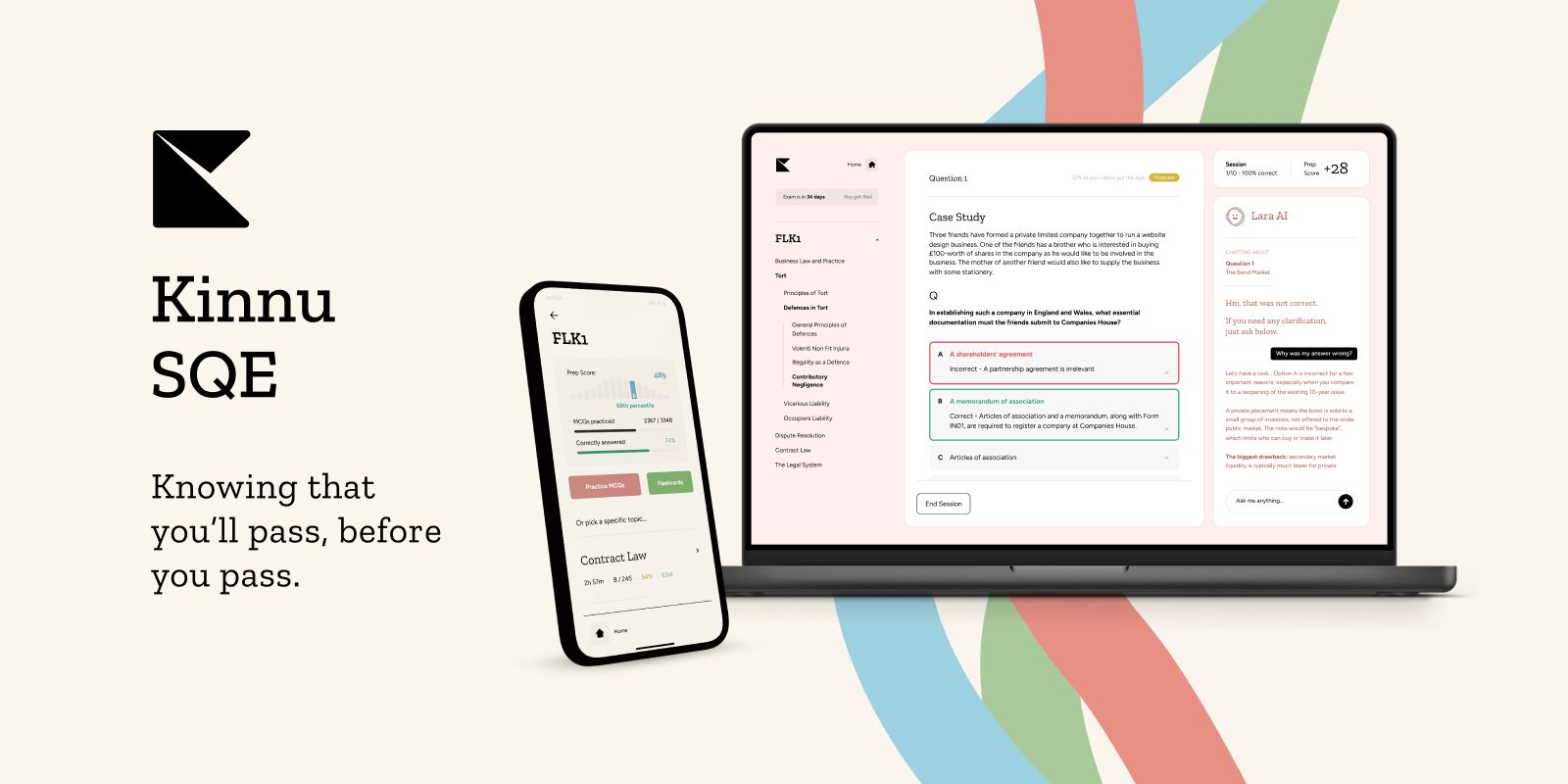
What is Kinnu?
Kinnu is a London-based edtech startup that has been building AI-powered learning tools since before the current AI boom made it fashionable. Founded in 2021, the company has raised close to $9 million in funding from major investors including LocalGlobe, NAP Ventures, Spark Capital and Repeat Ventures.
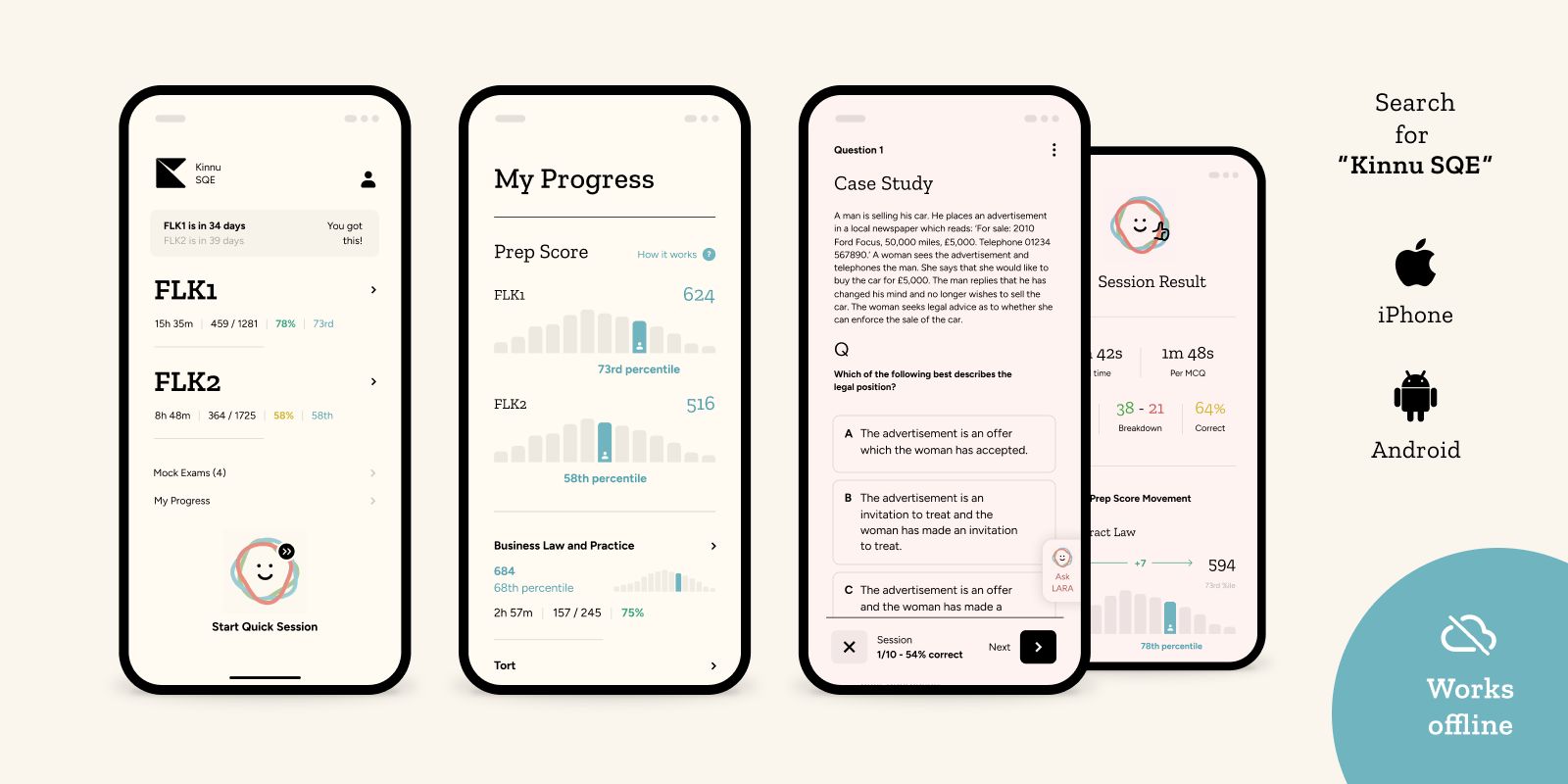
Originally focused on subjects like psychology, history and science, Kinnu has now brought that same learning platform to SQE prep. At your fingertips are study notes, MCQs, mocks, flashcards and study tips, all connected in one place, available across web and mobile, with offline functionality too.
What you get
- MCQ bank with practice questions across the SQE1 curriculum
- Study notes covering all tested topics
- Full mock exams simulating real exam conditions
- Flashcards with spaced repetition
- Stats and performance tracking
- Prep Score: their proprietary readiness predictor
- Lara AI running through all of the above as your personal study assistant
- Available on web and mobile, with offline access
So, we’ve got an established learning app developer, with genuine AI expertise, now applying that to SQE preparation. The question is, is it actually any good?
Lara AI
Every feature in Kinnu is underpinned by Lara, their SQE-specific AI model. And I want to spend proper time on this because it’s where Kinnu either earns its pitch or doesn’t.
When most prep providers say “AI-powered” what they actually mean is: we’ve put a chatbot on our website. You ask it something, it answers, and it has absolutely no idea what you were just studying, how you’ve been performing, or where you are in your preparation. It’s useful the way Google is useful, but it isn’t personalised, and it isn’t learning anything about you.
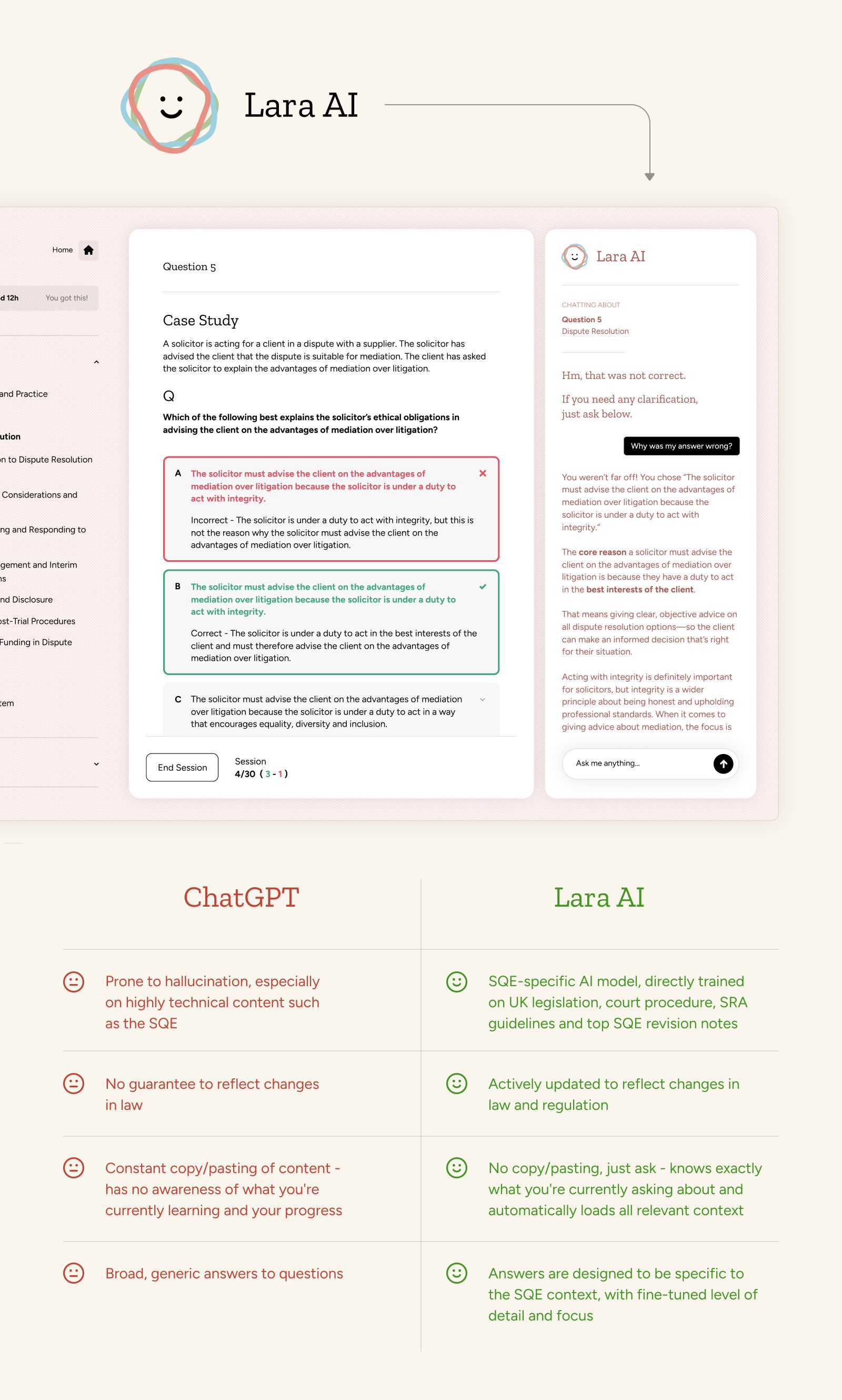
Lara is different. When I was working through MCQs, Lara knew exactly which question I was on, what I’d got right, what I’d got wrong, and what I was looking at in that moment. When I asked it to explain a concept, it explained that specific concept in that specific context, not a generic definition scraped from somewhere on the internet. This is what’s called context-aware AI, and the difference in practice is significant. Perhaps not the best analogy, but I would liken it to having a tutor on call throughout your study session.
SQE1 MCQ bank and practice questions
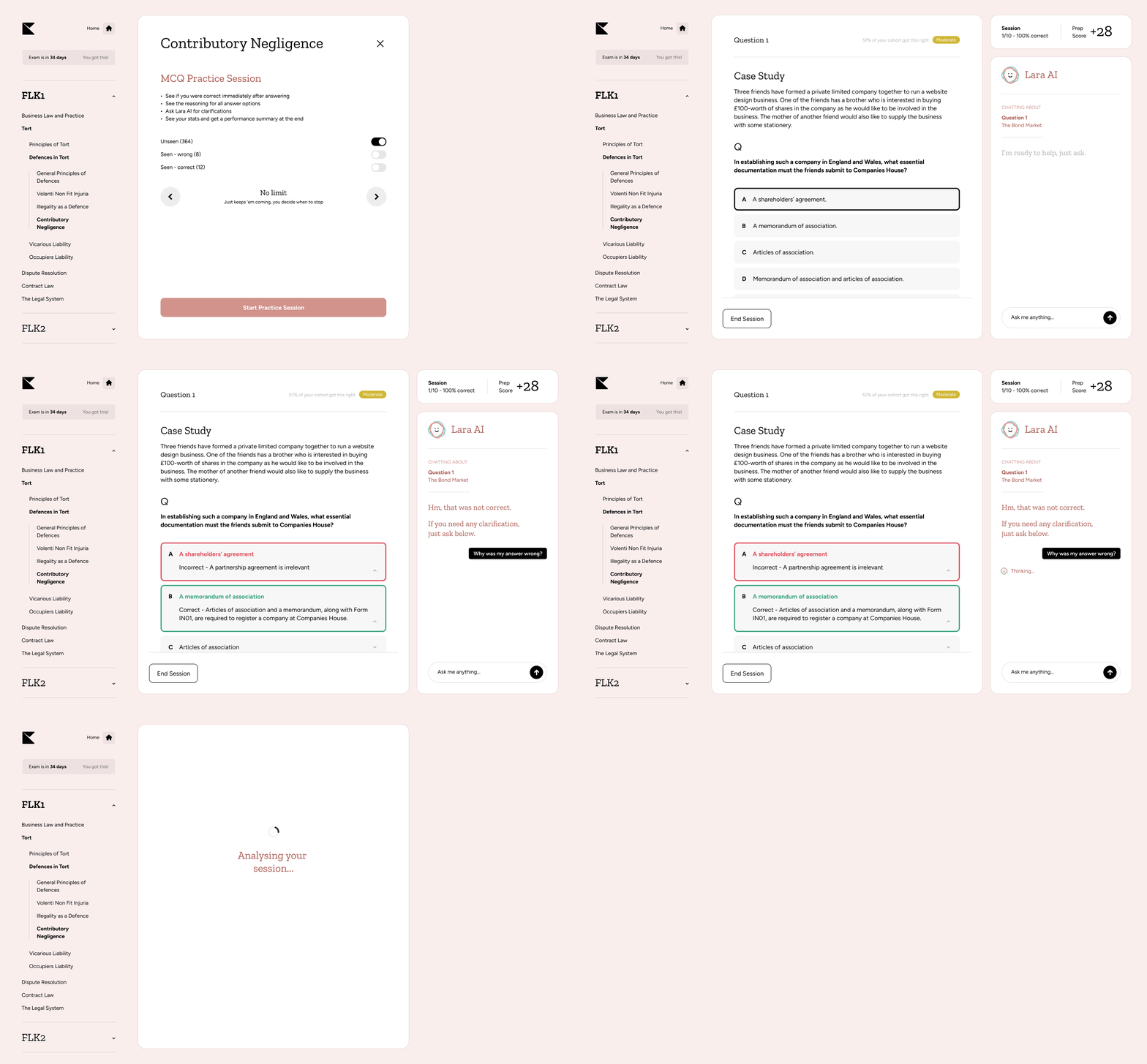
The SQE1 practice question bank covers the full curriculum and is where most candidates will spend the majority of their time. A few things worth highlighting:
Session length
You can choose 10, 20, 30 questions, or no limit at all. Small thing, but it means you can fit a session into whatever time you actually have rather than abandoning it because you haven’t got an hour.
Practice mode vs exam mode
Practice mode lets you review each question as you go. Exam mode is time-limited and you review everything at the end, closer to real exam conditions. Both are useful at different stages of preparation.
The reasoning
This is the part I care most about. After every MCQ you get the full reasoning for all answer options: not just why the right answer is correct, but why each of the wrong ones is wrong. If you can’t explain why you got something wrong (or right) you haven’t actually learned from it. In the SQE MCQ you cannot afford flukes. A correct answer you can’t explain is just a ticking clock. Kinnu’s answer reasoning directly addresses this.
Lara at question level
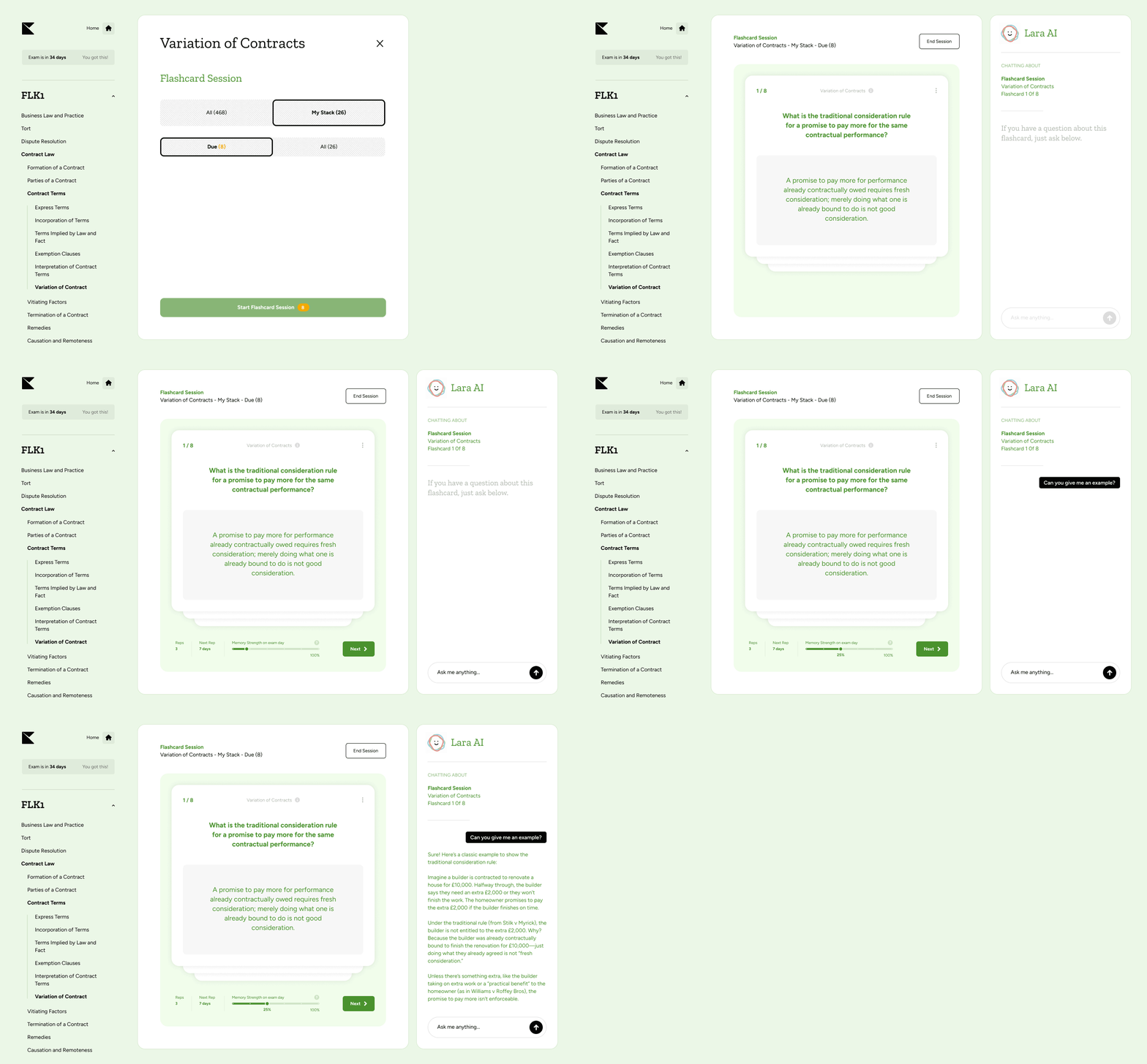
You can start a conversation with Lara on any question without leaving it. Instant clarification, deeper explanation, worked examples, all in context. This was one of the most useful things about the platform in practice.
Study Notes
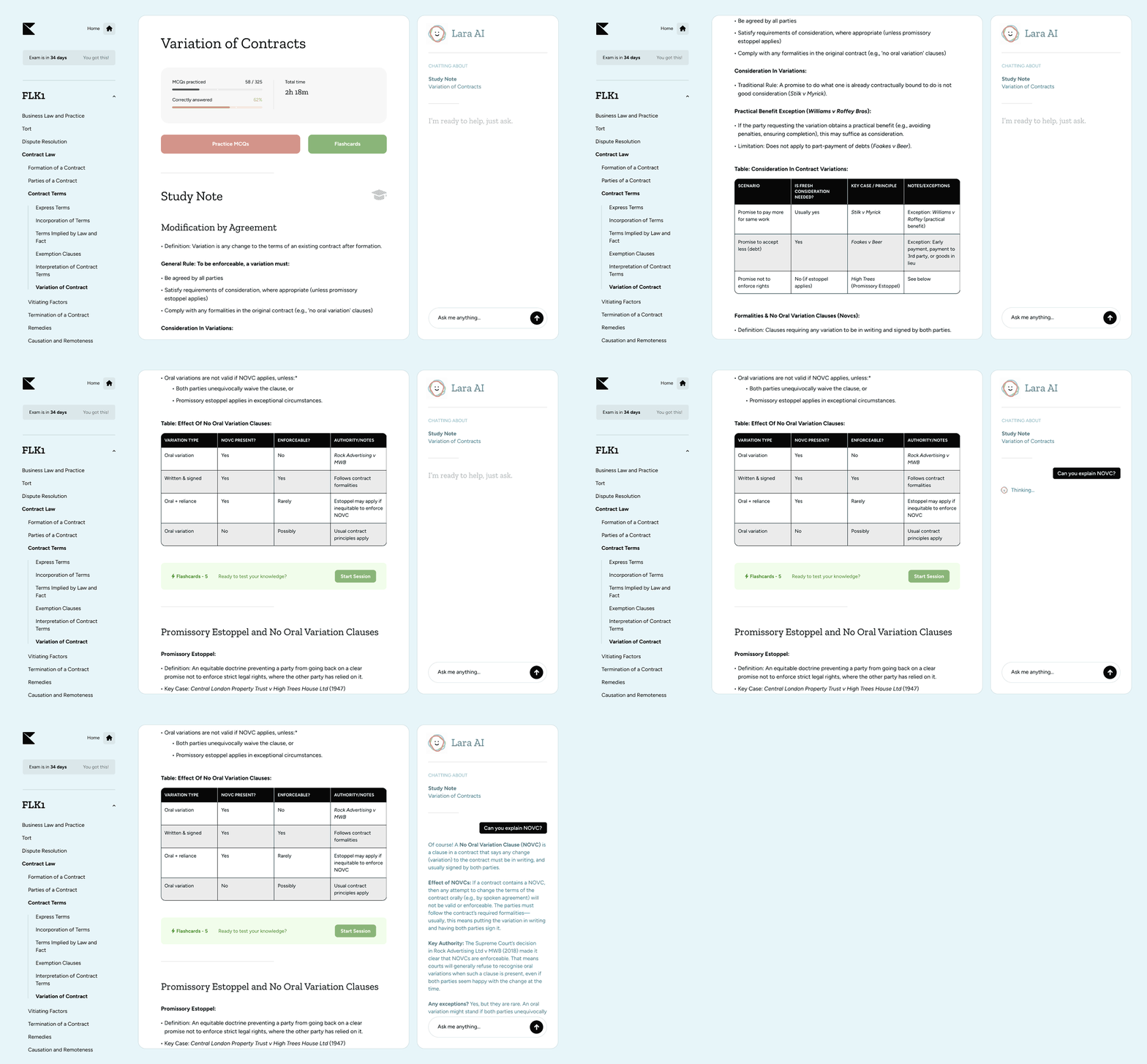
One feature I think deserves more credit is the study notes themselves, not least because they’re actually useful. They’re concise without feeling watered down, structured around the SQE syllabus, and written in a way that feels designed for revision rather than like someone copied chunks out of a textbook and hoped for the best.
What I liked most was how naturally everything linked together. The notes, MCQs and flashcards all connect to each other, so if I realised I was shaky on a topic, I could move between them pretty easily instead of spending half my revision session jumping between different platforms and tabs trying to piece everything together myself (which, take it from me, is nothing short of chaos).
Flashcards
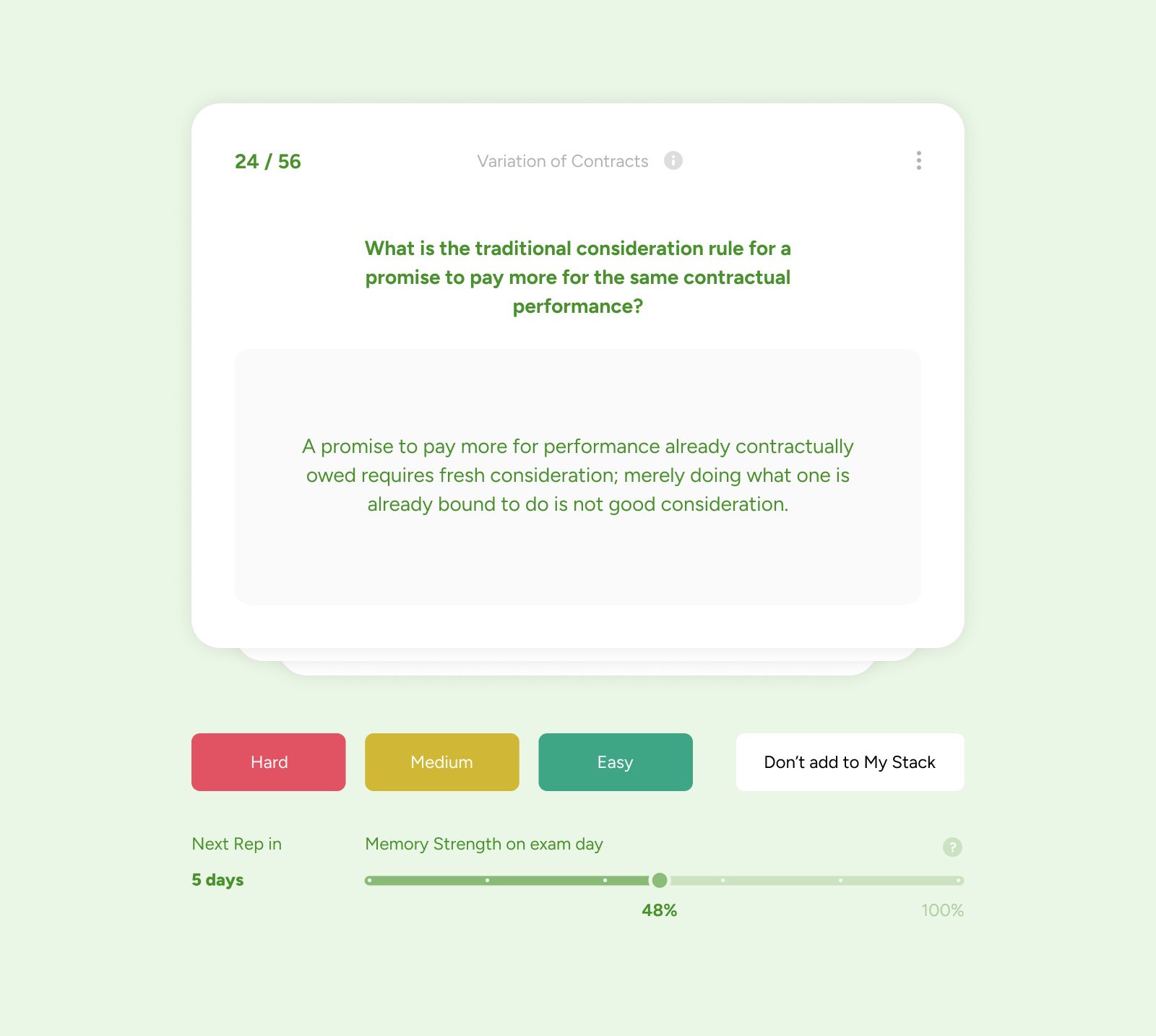
Kinnu’s flashcard system uses spaced repetition: cards you find harder or haven’t seen recently come up more frequently, while well-known cards are spaced out over longer intervals. The algorithm is specifically calibrated for exam day performance rather than long-term memory formation, so you peak when it counts rather than three weeks later.
You can mark each card as Hard, Medium or Easy, build custom stacks, and create your own cards directly from the study notes. Lara is available here too.
SQE1 mock exams
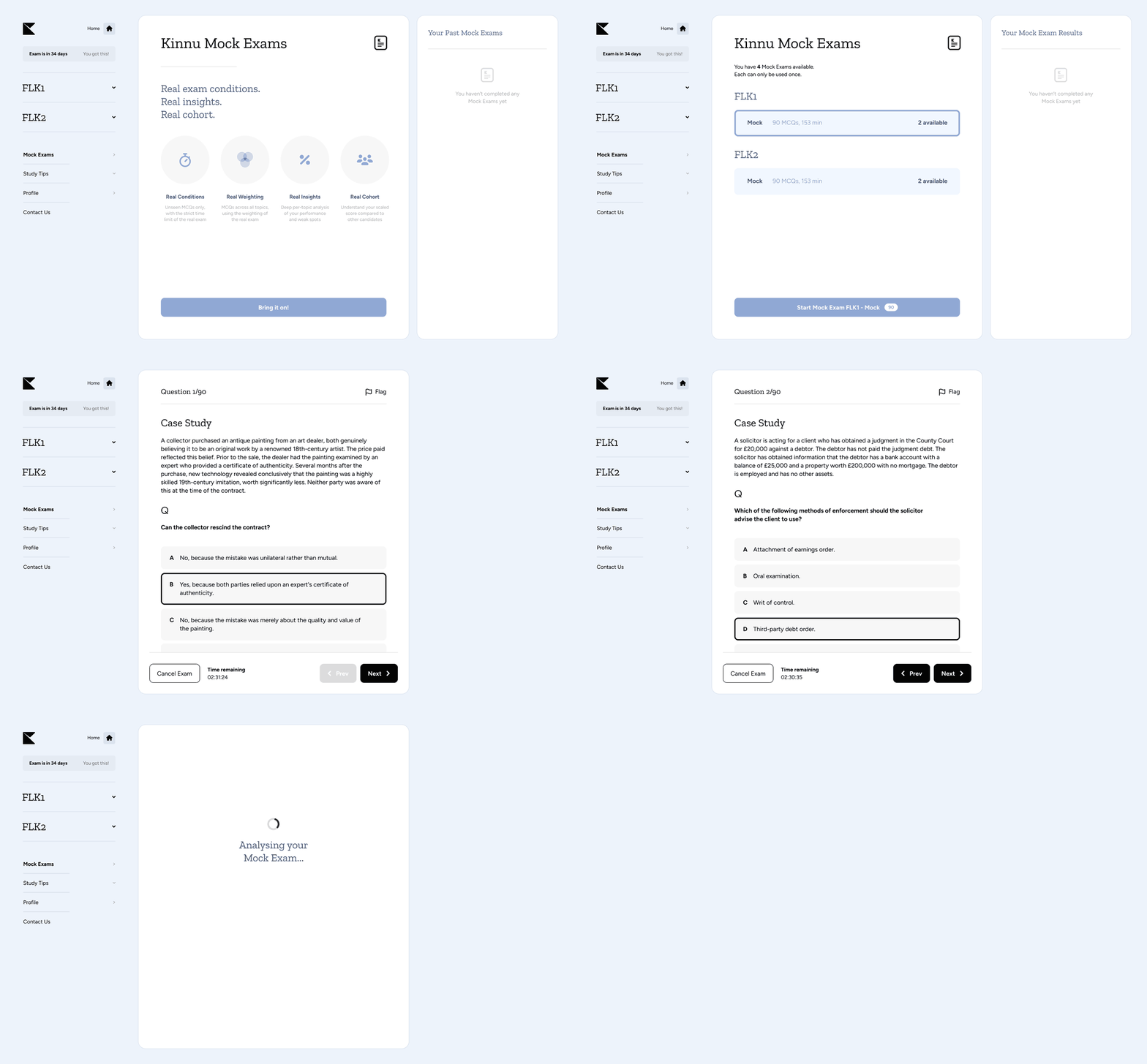
Most SQE1 candidates underestimate how different exam conditions feel to desk practice. Sustaining focus and accuracy across 180 questions under time pressure is a skill in itself — one that only gets easier with proper full-paper practice.
Kinnu’s mock exams are timed, cover the full SQE1 curriculum, and give you the same detailed reasoning breakdown as the MCQ bank. That matters more than it sounds: most SQE1 mock resources give you a score. Kinnu shows you why you went wrong on each question, and what you were actually missing — which is where the real learning happens.
The performance analytics afterwards are also worth mentioning. You can see exactly which topics you struggled with under exam pressure versus everyday practice — two things that often diverge more than candidates expect.
Stats and performance tracking
The platform tracks everything automatically: questions attempted, accuracy by topic, time spent, weaker areas highlighted. I’m someone who manually keeps a mistake log and tracks MCQ scores in a spreadsheet. Kinnu does all of that in the background without you having to think about it (which is helpful when you have a million other things to be thinking about).
Prep Score and the 94% claim
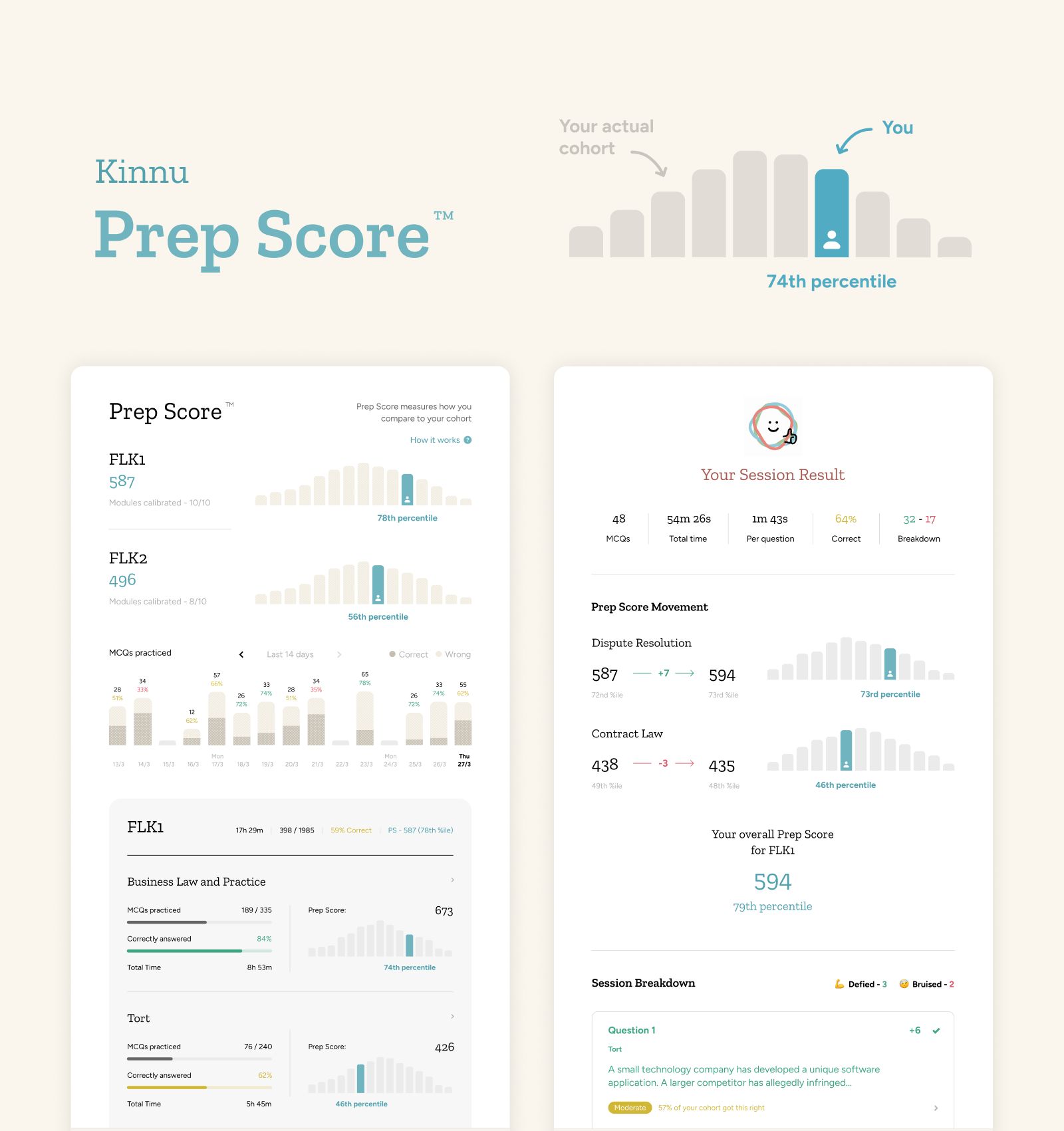
Here’s something I can share that hasn’t been published anywhere else yet. Kinnu’s proprietary Prep Score metric, which predicts whether you’ll pass or fail your SQE sitting based on your performance on the platform, is reporting 94% accuracy.
Prep Score goes beyond a simple percentage correct. It factors in three things:
- Your performance across practice questions
- The difficulty of the questions you've been answering
- How your performance compares to other candidates sitting the same exam
So instead of “you got 68% right in Criminal Law,” you get a genuine signal of how prepared you actually are relative to the standard required to pass.
That’s a meaningful shift if you think about what it replaces. Most candidates spend months with no real sense of whether they’re ready; the countless Reddit threads I’ve come across can attest for how common of a question this is among candidates.
The elephant in the room: the risks of AI in exam prep
I’d be doing you a disservice if I didn’t address this honestly.
As I mentioned, I work somewhere that sees real benefits from AI every day, but I am also exposed to the scepticism. That scepticism is not irrational. It’s appropriate, and anyone who tells you otherwise is selling something. A fantasy, most likely.
The core problem with AI study tools is hallucination. AI systems can produce incorrect information stated with complete confidence, and in an exam prep context that’s particularly dangerous. You’re not reading for interest. You’re building a mental model of the law that you’ll apply under real exam conditions. An inaccuracy that feels authoritative can embed itself in your understanding and cost you marks months later.
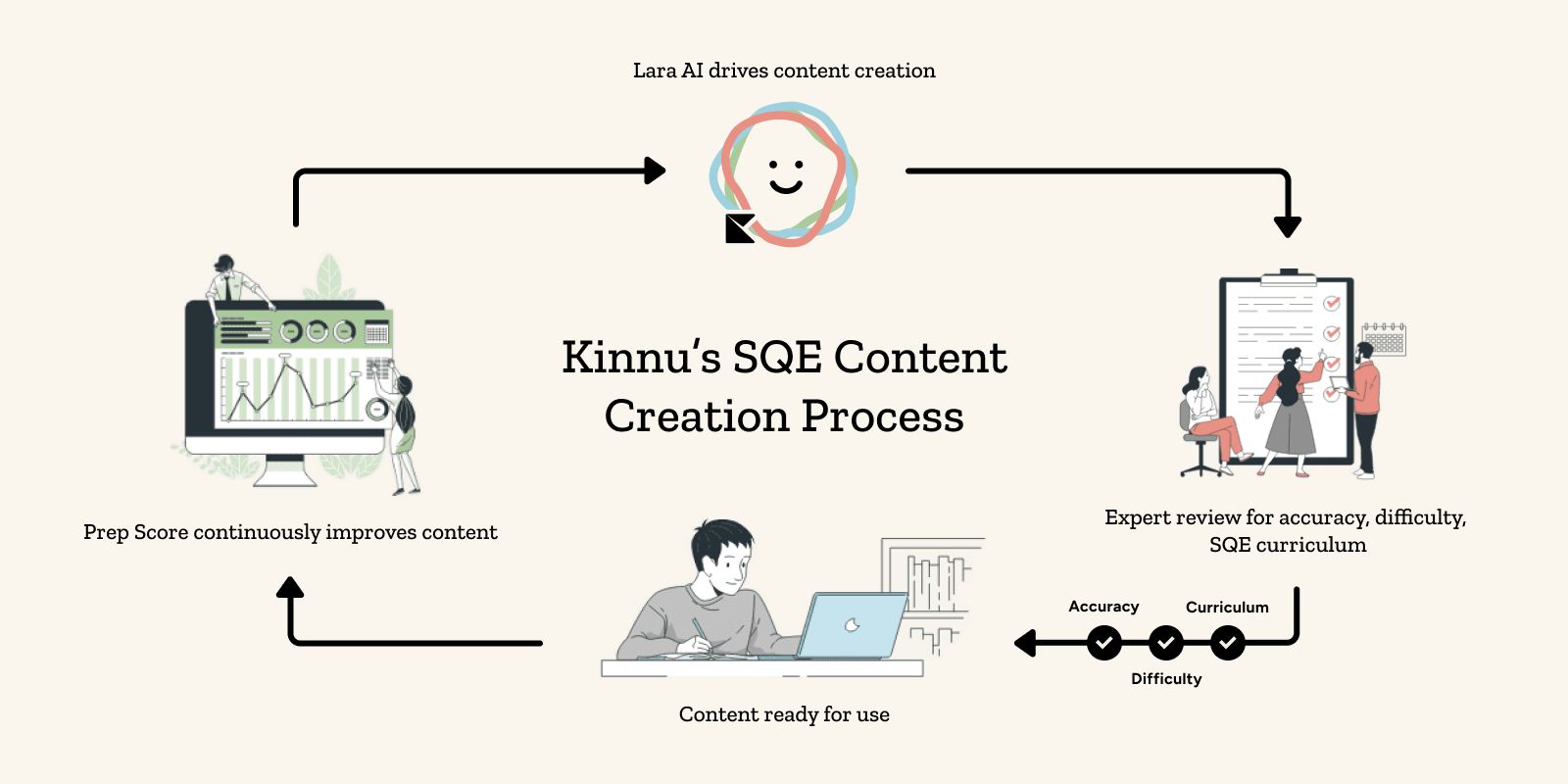
This is where Kinnu’s pipeline matters. Content is verified three times by three people who have actually passed the SQE before it ever reaches users. We live in an age where generating content is easy; evaluating whether that content is actually accurate is the hard part. That evaluation process is clearly something Kinnu takes seriously, and honestly, it’s one of the main reasons I felt more comfortable using the platform in the first place. Kinnu is also actively working to improve accuracy through real candidate performance data, feeding results back into content refinement as more SQE candidates use the platform. It gets more calibrated the more people go through it.
No tool is perfect and I’d never tell you to rely on any single source for SQE prep. But the question isn’t whether AI carries risk; it’s whether the specific tool you’re using has taken those risks seriously. From what I’ve seen, Kinnu has.
The mobile app
iOS and Android, offline access (except Lara), full feature parity with desktop. Rated highly on both the App Store and Google Play.
Pricing
£48/month
7-day free trial, no commitment
Use code QUALPATH20 for 20% off your first month
How Kinnu compares to other SQE1 resources
The SQE1 revision market broadly splits into three categories: full-service providers (BPP, ULAW, BARBRI), standalone MCQ platforms, and general-purpose AI tools. Kinnu sits in its own category.
| Resource type | SQE1 mocks | Answer reasoning | Readiness tracking | Cost |
|---|---|---|---|---|
| BPP / ULAW | Yes | Limited | Basic | £12,000–£15,000 |
| ChatGPT / general AI | No | Unreliable | No | Free / £20/mo |
| Revise4Law / Quizlet | Partial | Basic | Limited | Free – £15/mo |
| Kinnu SQE | Full mocks ✓ | Full reasoning ✓ | Prep Score + AI ✓ | £48/mo |
Who is Kinnu best for?
Kinnu suits you if:
- You're studying alongside work and need something that fits into short, irregular sessions
- You find passive reading and video watching difficult to sustain. The interactive format keeps you more engaged.
- You want to understand the full reasoning behind every answer, not just whether you got it right
- You know you should be tracking your performance properly but never quite manage it. Kinnu does it automatically.
- You want a platform that gives you an honest, data-backed read on whether you're actually ready
It’s probably not the right primary tool if you need live tutor support or structured classroom-style teaching. But as a preparation layer that keeps you active, accountable, and informed on your readiness, it does that very well.
Our verdict
What sets Kinnu apart is not any single feature. It’s the fact that the whole product is AI-native from the ground up. The MCQs, the study notes, the flashcards, the performance tracking, the Prep Score: all of it connected, all of it powered by Lara, all of it working together rather than a collection of separate tools bolted onto a platform. That joined-up experience is what makes the difference in practice.
It’s worth noting that Kinnu isn’t just being used by self-studying candidates. Trainees at Mishcon de Reya are using it too, which tells you something about the confidence legal employers have in the platform, and rightly so.
The answer reasoning on MCQs is the standout feature for me personally. Understanding why wrong answers are wrong is how you build the kind of robust knowledge that survives exam conditions rather than crumbling under them. That’s not a small thing. It’s the difference between preparation that holds up and preparation that falls apart the moment the questions get unfamiliar.
Prep Score is the most interesting thing I’ve seen in the SQE prep market in a while. A platform prepared to tell you honestly whether you’re ready, and back that prediction with a guarantee, is doing something most providers won’t do. The SQE is hard. You already know that. But hard doesn’t have to mean disorganised, flying blind, and hoping for the best. Kinnu is a tool that brings some structure and some honesty to the process, and after everything this exam puts people through, I think that’s worth quite a lot.
Try Kinnu here